Investing in the Future: A Comprehensive Guide to Emerging Sustainable Financial Instruments in 2025
As global environmental and social challenges intensify, investors are increasingly turning to sustainable financial products that offer both competitive returns and tangible societal impact. As global challenges such as climate change and social inequality capture worldwide attention, sustainable financial products have emerged as pivotal instruments for aligning investment goals with responsible practices. In 2025, innovative vehicles such as green bonds, ESG ETFs, and sustainability-linked bonds (SLBs) have taken center stage, enabling investors to participate in the global shift toward sustainability.
The emergence of sustainable finance has been driven by a convergence of factors. Heightened awareness of environmental challenges, stringent regulatory requirements, and the increasing recognition that responsible business practices foster long-term value have all contributed to a market that is estimated to reach nearly US$1 trillion by 2025 (Moody’s Insights; S&P Global Ratings). These products are not merely instruments for narrowing risk—they represent a dual commitment to achieving financial growth while ensuring meaningful social and environmental impact.
Understanding Sustainable Financial Products
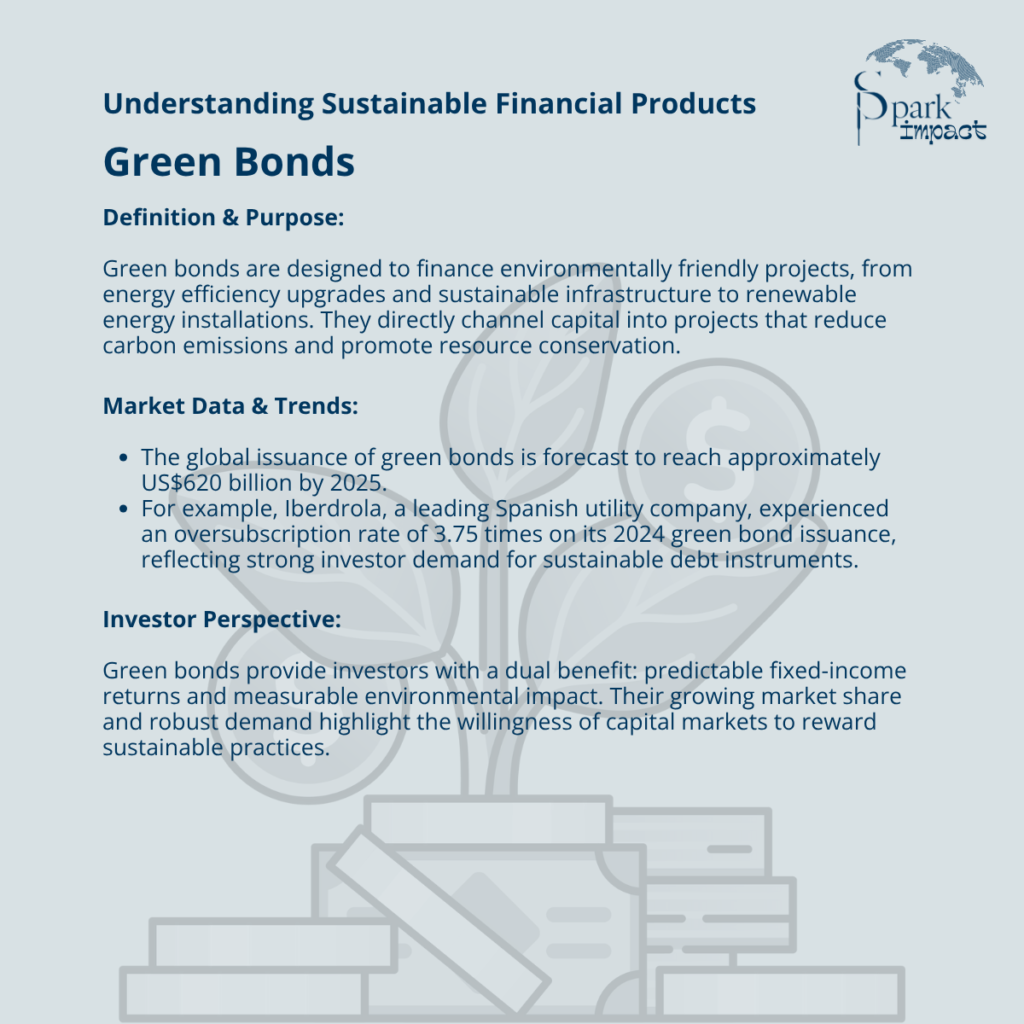
Sustainable financial products are designed to generate measurable environmental benefits or social good, alongside traditional returns. Green bonds, for example, are debt instruments where the proceeds are exclusively used for projects with clear environmental benefits, such as renewable energy installations or energy efficiency improvements. According to recent estimates, the global issuance of green bonds is forecast to reach approximately US$620 billion by 2025. A notable illustration is provided by Iberdrola, a leading Spanish utility company, whose 2024 green bond issuance was oversubscribed by a factor of 3.75, reflecting the robust investor demand for environmentally focused debt (ESG Today). In this context, green bonds offer the investor the unique advantage of capturing predictable fixed-income returns while contributing directly to projects that reduce carbon emissions and promote sustainable resource management.
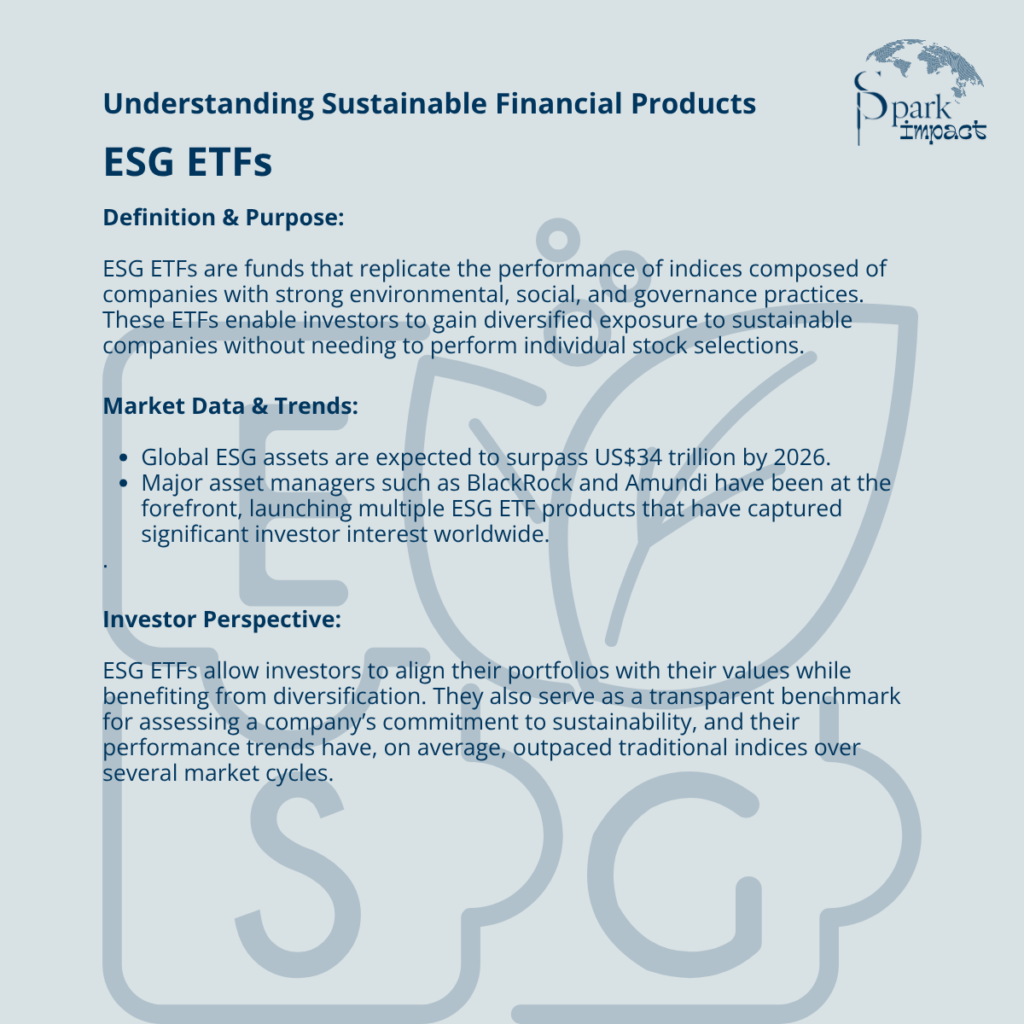
Equally transformative are ESG ETFs, which are structured to replicate indices composed of companies with superior environmental, social, and governance performance. Major asset managers, including BlackRock and Amundi, have significantly expanded their ESG ETF offerings, and recent forecasts suggest that global ESG assets could surpass US$34 trillion by 2026. These funds enable investors to gain diversified exposure to a portfolio of companies that meet strict sustainability criteria, therefore aligning investment portfolios with broader societal values. Historically, ESG ETFs have demonstrated performance that, on average, outpaces traditional indices, affirming the belief that sustainability factors not only mitigate risk but also enhance long-term returns.
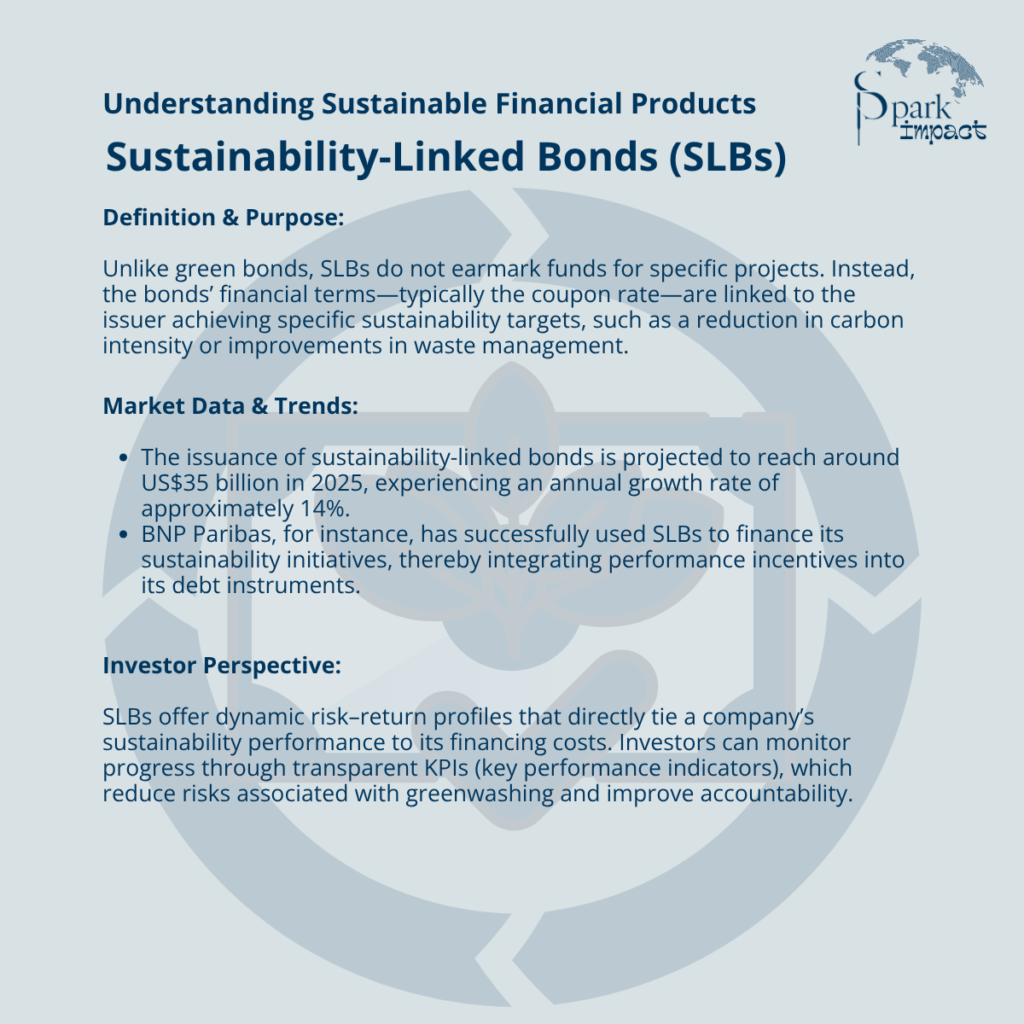
Beyond traditional green bonds and ESG ETFs, sustainability-linked bonds (SLBs) are gaining traction. Unlike green bonds, SLBs do not earmark funds for specific projects; instead, they link the financial terms—typically the coupon rate—to the issuer’s success in meeting predetermined sustainability targets, such as reductions in carbon intensity or improvements in waste management. Industry projections suggest that SLB issuance will reach around US$35 billion in 2025, growing at an annual rate of approximately 14%. A practical example is found in BNP Paribas’ use of SLBs to fund its sustainability initiatives, thereby aligning its financing costs with its environmental performance. This innovative design provides investors with dynamic risk-return profiles and transparent performance indicators, which help reduce the risk of greenwashing while enhancing accountability.
Evaluating Sustainable Financial Products
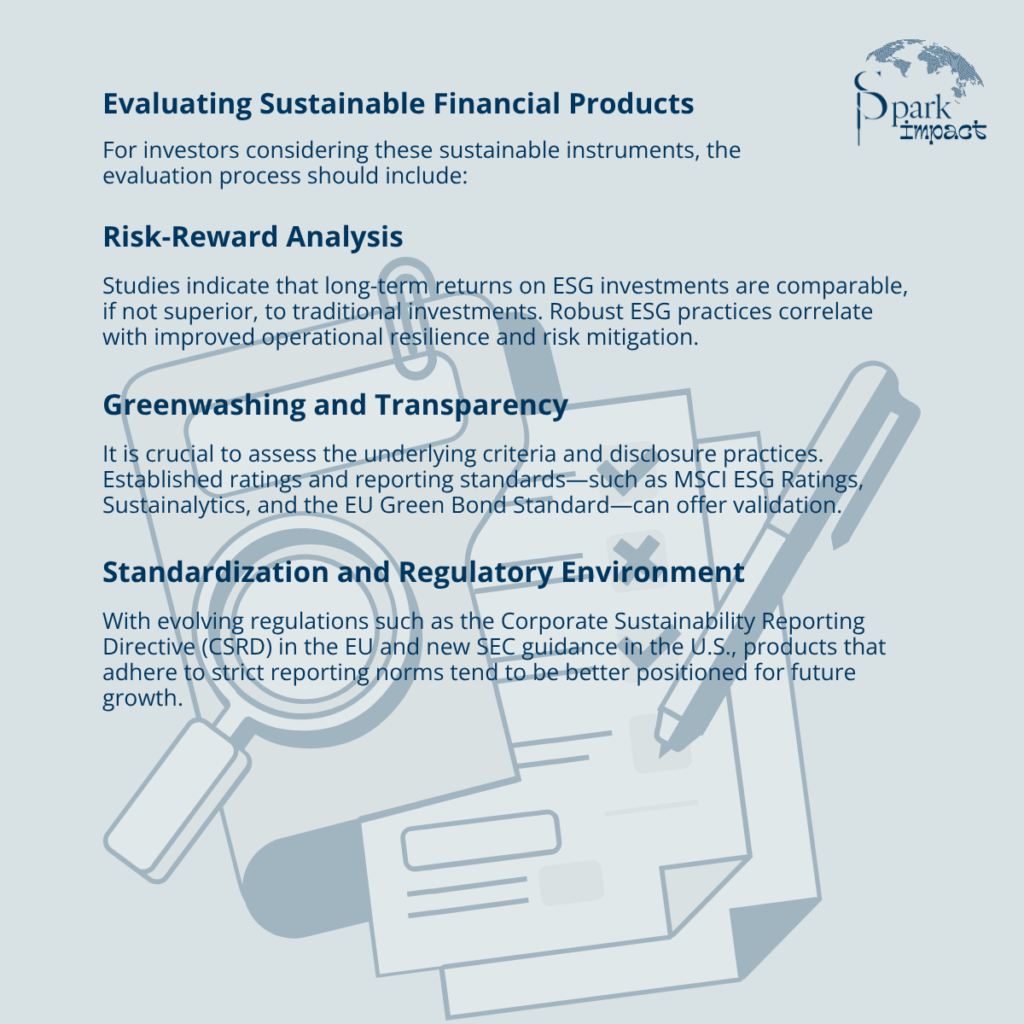
For investors evaluating these sustainable instruments, rigorous analysis is essential. A careful risk-reward examination shows that long-term returns on ESG investments can be comparable to, or even exceed, those of traditional investments when adjusted for risk. Academic research and market analysis consistently indicate that companies with robust ESG practices tend to exhibit improved operational resilience, a lower cost of capital, and superior growth trajectories. Furthermore, with the ever-evolving regulatory environment—characterized by frameworks such as the Corporate Sustainability Reporting Directive (CSRD) in the European Union and emerging SEC guidelines in the United States—sustainable products that adhere to strict reporting norms are better positioned to thrive. Transparency and adherence to standards provided by MSCI ESG Ratings, Sustainalytics, and the EU Green Bond Standard add further layers of credibility and reliability for the discerning investor.
Future Outlook and Opportunities
Looking ahead, emerging trends in sustainable finance are shaping the market landscape. Next-generation financial instruments, such as natural capital bonds, biodiversity-linked bonds, and evolving carbon credit trading platforms, promise to further refine risk-return dynamics in this space. Technological advancements, particularly the integration of artificial intelligence and big data analytics, are revolutionizing ESG analytics, thereby providing investors with granular insights into sustainability performance. Moreover, regional trends indicate that the Asia-Pacific region, especially countries like Japan, South Korea, and China, could become significant hubs for both the issuance and trading of sustainable financial products (Sustainability Magazine).
Regional Dynamics in Sustainable Finance
The evolution of sustainable finance is not uniform across the globe; it is significantly shaped by regional regulatory frameworks, economic priorities, and market maturity. In Europe, stringent regulatory initiatives such as the Sustainable Finance Disclosure Regulation (SFDR), the Taxonomy Regulation, and the Corporate Sustainability Reporting Directive (CSRD) are driving robust investor interest. The alignment of these policies with the EU Green Deal has enhanced transparency and increased market confidence, thereby attracting significant capital toward green bonds and other sustainable instruments. This well-defined regulatory environment is paving the way for a more standardized and efficient green bond market, as evidenced by the recent implementation of the European Green Bond Standard, which has already boosted investor confidence and market participation.
In contrast, the United States is charting its own course. While the regulatory landscape is evolving—with the Securities and Exchange Commission (SEC) proposing enhanced climate risk disclosure requirements—the market continues to be guided by investor sentiment and government stimulus measures such as the Inflation Reduction Act. Although the U.S. regulatory approach is generally less prescriptive compared to Europe’s, the nation’s policy initiatives and market-driven solutions are steadily building momentum for sustainable financial products. This shift is gradually harmonizing U.S. investment practices with global sustainability trends, albeit at a pace that allows for significant private sector input and innovation.
Asia-Pacific, however, stands out as a remarkable growth engine in sustainable finance. Recent data from Sustainability Magazine indicate that the region witnessed energy transition investments above US$1 trillion in 2024, registering a year-on-year growth of 21 percent—substantially higher than the global average of 11 percent. Mainland China leads these efforts with investments reaching nearly US$818 billion, while other economies like Japan and South Korea also contribute significantly through initiatives such as the issuance of climate transition bonds and robust renewable energy programs. The increasing focus on digital transformation, coupled with strong governmental support and strategic regional policies, underpins Asia-Pacific’s ability to scale sustainable finance solutions rapidly. Notably, international forums such as the UNEP FI Regional Roundtables on Sustainable Finance 2025 have provided platforms in Latin America, Africa, Asia Pacific, and North America for sharing best practices and fostering collaborative initiatives, reinforcing the region’s role as an emerging powerhouse in sustainable finance.
Moreover, the OECD-ADBI Roundtable on Capital Market and Financial Reform in Asia 2025, scheduled to be held in Tokyo, underscores the commitment of regional policymakers to integrating sustainable finance into the broader capital market framework. This dialogue highlights the advancements in utilizing artificial intelligence and big data for better ESG risk assessment, facilitating an environment where financial reform and sustainability are interwoven into the fabric of market operations. These initiatives not only strengthen domestic markets but also enhance the attractiveness of the region to international investors who are increasingly seeking diversified portfolios that support the global transition to a low-carbon, climate-resilient economy.
Collectively, these regional dynamics illustrate that the growth trajectory of sustainable finance is both multifaceted and robust. While Europe sets high regulatory benchmarks and the United States leverages market-driven innovation, Asia-Pacific is distinguished by its rapid expansion in capital investments and strategic policy innovations. For investors, understanding these regional nuances is essential to capitalize on emerging opportunities in sustainable finance and to contribute meaningfully to the transition toward a more sustainable and equitable global economy.In conclusion, sustainable financial products are transforming investment strategies by demonstrating that competitive financial returns and positive social impact are not mutually exclusive. Instruments such as green bonds, ESG ETFs, and sustainability-linked bonds enable investors to capture the premium associated with sustainable innovation and responsible growth. By employing robust evaluation metrics, adhering to international standards, and leveraging emerging technology, these instruments empower investors to play an active role in global sustainability initiatives while enhancing their financial portfolios.
In conclusion, sustainable financial products are transforming investment strategies by demonstrating that competitive financial returns and positive social impact are not mutually exclusive. Instruments such as green bonds, ESG ETFs, and sustainability-linked bonds enable investors to capture the premium associated with sustainable innovation and responsible growth. By employing robust evaluation metrics, adhering to international standards, and leveraging emerging technology, these instruments empower investors to play an active role in global sustainability initiatives while enhancing their financial portfolios.
You may also like